
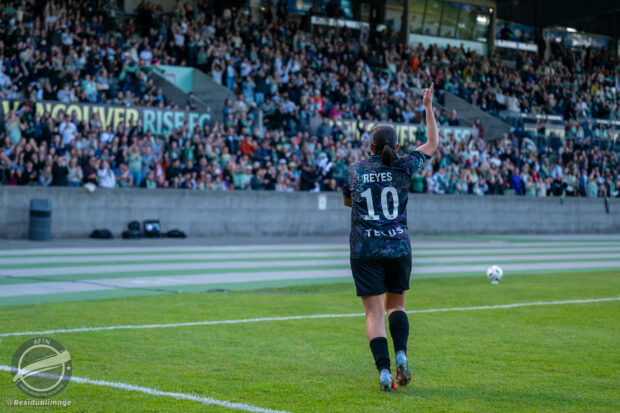
Vancouver Rise falls 3-2 to AFC Toronto in dramatic home opener
The second season for Vancouver Rise FC began with celebration and intensity Friday night, as fireworks, a trophy presentation, and a championship banner set the stage for a sold-out home opener of 4,723 against AFC Toronto, a rematch of the last year’s final and an immediate test for two sides expected to contend again.
Vancouver entered the match as reigning champions, opening a new chapter in front of a home crowd eager to celebrate the past while looking ahead. But after twice fighting their way back into the match and carrying a halftime lead, the Rise were undone by Toronto’s relentless wing play and high pressing structure, in a 3-2 defeat.
Toronto’s pressure set the tone early
Toronto imposed itself from the opening whistle, pressing aggressively and targeting wide areas, particularly through the presence of Esther Okoronkwo, whose influence was felt almost immediately. Vancouver struggled early to retain possession, frequently turning over the ball under pressure and too often clearing danger only to return possession to Toronto in dangerous areas around the box.
That pressure paid off in the 8th minute when Sarah Stratigakis combined down the left with Okoronkwo before Zoe Burns finished the move to open the scoring. It was a goal that reflected a first-half pattern, with Toronto repeatedly finding chances through openings in Vancouver’s defensive shape.
Through much of the first half, Toronto looked the sharper side, creating five early chances before Vancouver had one and forcing several key saves from Rise goalkeeper Morgan McAslan, whose interventions, particularly in a 1v1 stop against Stratigakis, kept Vancouver in the game. Toronto’s ability to press high, recover possession quickly, and transition into counterattacks made it difficult for Vancouver to establish rhythm, and for a long time the visitors looked remarkably comfortable for a season opener.

Vancouver showed resilience despite defensive struggles
Despite having to play a more defensive approach, Vancouver found moments of quality and showed the kind of resilience that helped define last season’s championship run.
A debut goal from Camila Reyes in the 18th minute shifted momentum, rewarding one of Vancouver’s few sustained attacking sequences of the half. And while Toronto continued to create chances, particularly through Okoronkwo’s movement and the physical presence of midfielders like Colby Barnett, Vancouver capitalized on its moments.
That was never clearer than before halftime when Latifah Abdu won possession near midfield, drove directly at the Toronto back line, and produced a brilliant solo finish to give Rise a 2-1 lead. It was one of the standout individual moments of the night and underlined an encouraging theme: even while creating fewer chances, Vancouver’s opportunities were converted into goals. The numbers reflected that efficiency. Vancouver finished with just five shots, three on target, and two goals.
Still, defensive issues lingered. Toronto consistently found space down the wings, and Vancouver at times hesitated in clearances or struggled in 1v1 duals, particularly against Okoronkwo. Several attempted defensive clearances merely recycled possession back to Toronto, extending pressure rather than relieving it.

Second-half adjustments changed the game
Toronto’s halftime adjustments proved decisive. Head coach Marko Milanovic credited tactical tweaks at the break, along with two set-piece goals, for changing the match. The impact was evident almost immediately as Toronto emerged with renewed control, circulating possession more effectively and continuing to exploit wide channels.
Stratigakis equalized in the 61st minute, shifting back momentum to the visitors, before Toronto fully regained control of the match. Okoronkwo, a constant threat all evening, added the winner in the 72nd minute after again exploring space out wide, capping a performance that repeatedly tested Vancouver’s defensive shape.
Still, Vancouver had its moments. A skillful flick by Maithé López, nearly created a late equalizer for Abdu in one of Rise’s best second-half sequences, and Okamoto’s effort off the crossbar in the 78th minute came inches from leveling the match. But Toronto, comfortable both defending and countering, managed to maintain the result.

Lessons for a new-look Rise side
For Vancouver, the performance highlighted both promise and areas requiring adjustments. With significant offseason turnover, chemistry remains a developing theme, but head coach Anja Heiner-Mœller pointed to the team’s resilience and chance creation as positives. Her assessment was notably measured, acknowledging both imperfections and encouraging signs.
Possession, however, was a key area she identified for growth, particularly switches through midfield and improved control in buildup. Vancouver’s ability to move centrally from one side to the other, something she noted as crucial to chance creation, remains an area she wants improved.
Defensive management in wide areas and 1v1 situations, especially against elite attackers like Okoronkwo, also emerged as focal points. Heiner-Mœller emphasized the need to ensure support arrives quickly when players like Okoronkwo receive the ball, limiting space before attacks can develop.
“We’re still producing the chances,” Heiner-Mœller said post-match. “For a first game, this was okay… looking at the performance, and talking about that we wanted to be satisfied with the effort at least in the end, I think we can be.”
A rivalry renewed
If last year’s final created a rivalry, Friday suggested this is only the beginning. Toronto captain Nikayla Small admitted Vancouver’s pre-match title celebration added motivation, saying the atmosphere and ceremony helped fire up the visitors.
For Vancouver, the result stings, particularly after holding a halftime lead, but the match also offered evidence that even amid transition, the reigning champions remain capable of competing at a high-level. The execution was not perfect, but the intensity was undeniable.

 Previous Article
 Next Article
I didn’t watch the game, but the comments were very insightful. Thank you!